3D Printed Parts
customized.
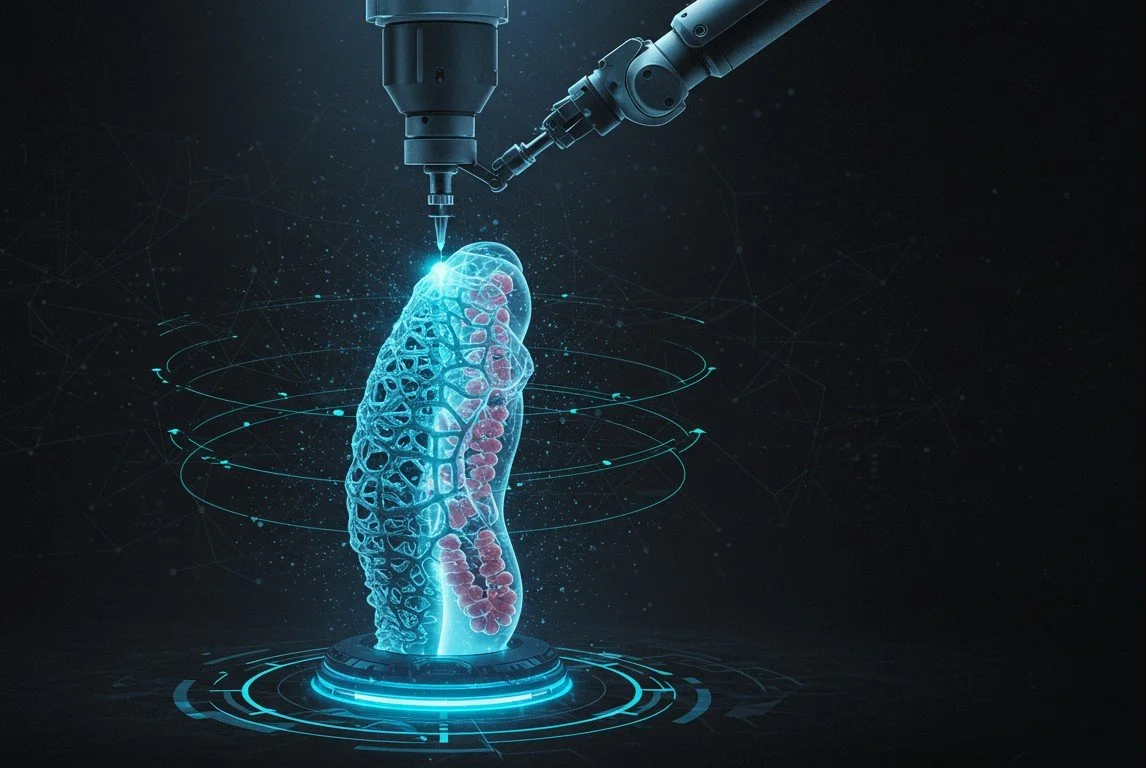
ALT provides end-to-end additive manufacturing services — from rapid prototyping and production tooling to novel 3D printing materials and processes developed specifically for Physical AI, robotics, and high-performance engineering applications.
Additive manufacturing is not just a faster way to make parts — it is the only viable production method for the complex geometries, embedded sensor channels, and gradient material structures that Physical AI systems demand. ALT engineers additive from the material up.
Two tiers of additive capability.
Most AM service bureaus offer COTS printing. ALT adds a second tier: proprietary material formulations and novel additive processes developed in-house for applications that standard materials can't serve.
Standard & engineering-grade 3D printing
Production-ready thermoplastics, high-performance engineering polymers, carbon fiber composites, and DLP resins — printed on calibrated, process-controlled systems with fast turnaround.
- Rapid prototyping in PLA, PETG, ABS, ASA
- High-strength carbon fiber composites (PAHT-CF, PPA-CF, PC-CF)
- High-temperature engineering polymers: PEEK, PEI/Ultem, PPSU
- Flexible & elastomeric parts: TPU, TPE, NinjaFlex
- High-resolution DLP resin for anatomical models & fine detail
- Multi-material & multi-color via Bambu AMS system
- Large-format printing for tooling, jigs & fixtures
Proprietary materials & novel additive processes
ALT-developed material systems and additive processes for applications where COTS doesn't meet the mechanical, biological, or functional requirements — especially for Physical AI, robotics, and prosthetics.
- Synthetic tissue composites: programmable stiffness gradients for prosthetics & soft robots
- Biomimetic ceramic composites: nacre & bone-inspired toughness architectures
- Gradient material printing: continuous rigid-to-flexible transitions in a single build
- Multi-functional embedded structures: sensor channels & conduits integrated in-print
- Conductive & piezo material printing for PCBs and embedded sensors
- Novel process development for custom material characterization
Full-spectrum AM capabilities.
ALT maintains a curated fleet of calibrated additive manufacturing systems across multiple technologies, augmented by custom-built platforms for novel material processes.
Fused Filament Fabrication (FFF/FDM)
Our primary workhorse process. Calibrated FFF systems for standard through high-temperature engineering materials. Multi-material capability via AMS for single-build multi-component prints. Optimized process parameters per material family.
High-resolution DLP resin printing
25–100 micron resolution for fine-detail parts, anatomical models, surgical training devices, and casting patterns. Multiple resin formulations: standard, tough, flexible, castable, and biocompatible.
Multi-material & gradient printing
Single-build parts combining rigid structural zones with compliant elastomeric regions — eliminating assembly steps for prosthetics, grippers, and soft robotic end-effectors. Proprietary gradient material process spans Shore 35A to rigid PC.
Carbon fiber composite printing
High-strength CF composite filaments (PAHT-CF, PPA-CF, PC-CF, ASA-CF) on hardened-nozzle systems with topology-optimized geometries. Maximum strength-to-weight for drone airframes, robotic limbs, and structural components.
Embedded sensor & electronics printing
Conductive, insulative, and piezo material printing for in-structure sensors, PCB traces, and functional electronics — integrated during the build rather than assembled afterward. Key capability for Physical AI hardware.
Tooling, jigs & production fixtures
Rapid production of custom tooling, assembly jigs, inspection fixtures, and soft tooling for low-volume manufacturing runs. Faster and lower-cost than CNC machined equivalents for quantities under ~50 units.
What we build with additive manufacturing.
ALT's additive manufacturing capabilities serve a range of applications — from standard engineering parts to Physical AI structures that couldn't be made any other way.
From file to finished part.
ALT's end-to-end additive manufacturing workflow — from initial design consultation through delivery of production-ready parts.
Design & DFM review
We review your CAD file or work from your requirements to optimize geometry for additive manufacturing — wall thickness, support strategy, orientation, and material selection.
Material selection
COTS or novel material recommendation based on mechanical requirements, environment, biocompatibility, and process constraints. Full material portfolio available.
Process & parameter optimization
Slicing, print calibration, print orientation, layer height, infill strategy, and support generation — all tuned per material and application for optimal mechanical performance.
Print & QC
Production on calibrated systems with in-process monitoring. Post-print dimensional inspection and functional testing as required.
Post-processing & delivery
Support removal, surface finishing, painting, assembly, or integration as needed. Local delivery in Santa Barbara or nationwide shipping.
Why ALT for additive manufacturing.
Most 3D printing services print standard materials on standard machines. ALT combines production AM capability with in-house material science and Physical AI integration — for applications that require more than a print bureau can offer.
Novel materials, not just standard filaments
ALT develops proprietary material formulations for applications where COTS materials don't meet requirements — synthetic tissues, biomimetic composites, gradient structures — capabilities no standard print bureau offers.
Physical AI integration
Parts don't just need to be printed — they need to house sensors, route signals, and interface with edge AI systems. ALT designs and prints these structures as integrated systems from the start.
US-based, fast turnaround
All design, engineering, and fabrication in Santa Barbara, CA. No overseas supply chain risk. Typical rapid prototype turnaround 24–48 hours; production runs quoted on request.
Engineering support, not just printing
ALT provides design-for-additive-manufacturing (DfAM) consultation, topology optimization, material testing, and reverse engineering — not just file-to-print execution.
Process-controlled, calibrated systems
All printers are actively maintained and calibrated. Process parameters are documented and repeatable. Critical for applications where mechanical consistency matters — robotics, medical, aerospace.
Common questions.
Answers to the questions engineering teams and product developers ask most frequently about ALT's additive manufacturing services.
Ready to start your
additive manufacturing project?
From rapid prototyping to novel material development — tell us what you need and ALT will scope it.