
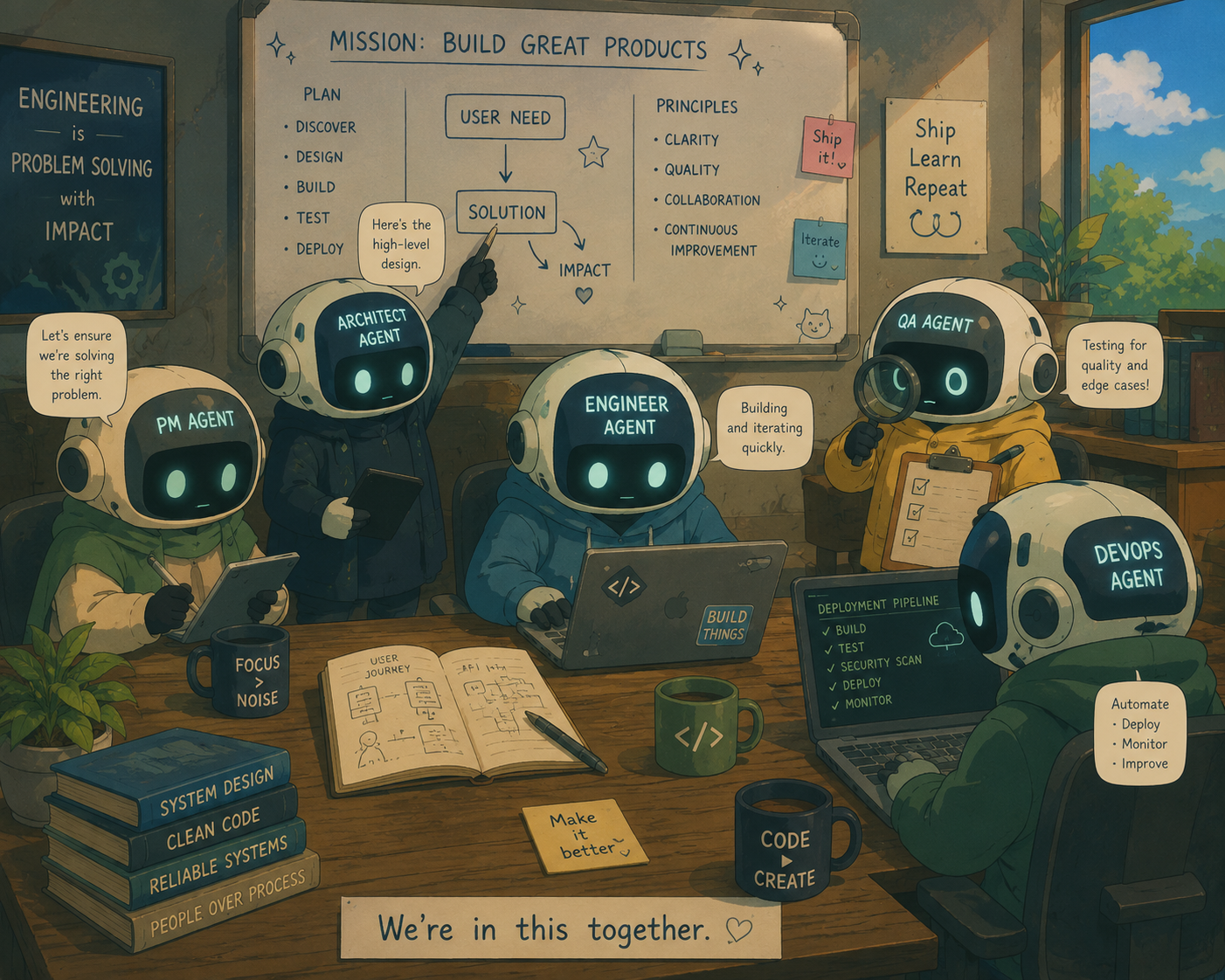
How AI Agents Are Transforming Engineering Workflows
Using AI Agents to develop Automated Engineering Workflows
By Jonathon Barton, PhD | ALT LLC
The engineering industry is at an inflection point. What began as simple automation scripts has evolved into something far more capable: AI agents that can reason, plan, and execute complex tasks with minimal human oversight. For companies still relying on manual workflows, the gap between their processes and what's now possible is widening fast.
At ALT LLC, we've spent the past few years building custom AI agents for engineering clients and automating our own processes — from design review pipelines to private LLMs handling sensitive proprietary data. Here's what we've learned about where AI agents fit, where they fall short, and how to implement them without introducing more problems than they solve.
What Is an AI Agent, Actually?
The term gets used loosely, so it's worth being precise. An AI agent is a system that can perceive its environment (read files, query databases, parse sensor data), reason about what it observes, and act on those decisions — generating reports, modifying designs, triggering downstream processes. This is fundamentally different from a chatbot. A chatbot responds to prompts. An agent takes a goal, "review this CAD file for manufacturing tolerances," and autonomously executes a sequence of steps to achieve it. In practice, most engineering AI agents pair a large language model (the reasoning engine) with tool access — APIs, file systems, simulation software, databases. The LLM decides what to do; the tools let it actually do it.
Where Agents Add Real Value
The highest-value applications share common traits: they're repetitive, data-heavy, require cross-referencing multiple sources, and currently consume expensive human hours on low-judgment work.
Automated design review is one of the most impactful use cases we've implemented. An agent can parse a CAD file, check dimensions against specifications, flag manufacturing issues like undercuts and tolerance violations, cross-reference material properties databases, and generate a structured review report — in minutes, not hours. It doesn't replace the engineer's judgment on whether a design is good. It eliminates the tedium of verifying that it meets spec.
Material selection is another strong fit. You're balancing mechanical properties, thermal behavior, chemical compatibility, cost, lead time, and regulatory requirements across hundreds of candidates. We've built agents that ingest a project's constraints and produce a ranked shortlist with justification. The agent doesn't need to be an expert materials scientist — it needs to be a fast, thorough cross-referencer that never forgets to check a critical property.
Documentation and compliance work is also well-suited to agents: auto-generating first drafts from structured data, cross-checking against regulatory frameworks, maintaining traceability between design decisions and test results, flagging inconsistencies across a project's document set. In regulated industries, documentation gaps can delay product launches by months. Agents don't solve the underlying complexity, but they close the gap between where documentation should be and where it actually is.
The Hallucination Problem
The biggest objection we hear from engineering leaders: "I can't have an AI making things up about my designs." It's a valid concern. LLMs hallucinate — they generate plausible-sounding but incorrect information with confidence. In engineering, a fabricated material property or test result isn't just wrong; it's dangerous.
The most important architectural fix is Retrieval-Augmented Generation (RAG): instead of relying on the model's training data, the agent retrieves relevant documents from your actual databases and knowledge bases before generating any answer. A well-designed RAG system reduces hallucination from "frequent and unpredictable" to "rare and detectable." Alongside this, we constrain critical outputs to structured formats — JSON schemas, checklist completions, numerical ranges. If an agent reports tensile_strength_mpa: 450 against a database value of 350, the discrepancy is immediately visible. Freeform prose makes that same error invisible.
We also design every workflow with explicit human review checkpoints at critical junctures. The agent handles the 90% of work that's mechanical and repetitive; a human reviews the 10% that requires judgment. This isn't a failure mode — it's the optimal division of labor. Finally, every claim an agent makes should trace back to a source document. If the agent can't find sufficient evidence, it should say so rather than guess. Building that "know when you don't know" behavior is one of the hardest problems in AI deployment, and one of the most valuable.
A Note on Private Deployment
Most engineering companies can't send proprietary designs, test data, or client information to cloud APIs. At ALT LLC, we deploy private LLMs on client-owned infrastructure using open-weight models, with the same RAG pipelines, tool integrations, and workflow orchestration as cloud-based systems — but inference runs entirely within the client's network. The tradeoff is real: you need GPU infrastructure, and open-weight models may not match frontier models on general reasoning. For domain-specific tasks, though, a fine-tuned smaller model often outperforms a general-purpose one.
Getting Started
If you're considering AI agents for your engineering workflows, we recommend beginning not with the technology but with the bottleneck. Don't ask "where can we use AI?" Ask "what process is slowing every project down?" Then automate that one thing first, prove the value, learn the failure modes, and expand.
Before building any agent, invest in your data infrastructure. AI agents are only as good as the data they can access — which means your engineering data needs to be stored in accessible formats, properly tagged, version-controlled, and queryable via standard interfaces. And from day one, define how you'll measure success: accuracy, time savings, error rates, user satisfaction. The first version of any agent will be imperfect. The goal is to build something you can iterate on without rebuilding from scratch.
AI agents aren't going to replace engineers. They're going to eliminate the 60–70% of engineering work that's data processing, cross-referencing, documentation, and verification — the work that consumes time but doesn't require human creativity or judgment. The companies that figure this out first will have faster design cycles, lower costs, fewer errors, and engineers free to focus on work that actually requires human expertise.
ALT LLC is a Santa Barbara-based engineering company specializing in additive manufacturing, custom robotics, AI automation, synthetic tissues, and advanced prosthetics. Learn more at 3dalt.com.